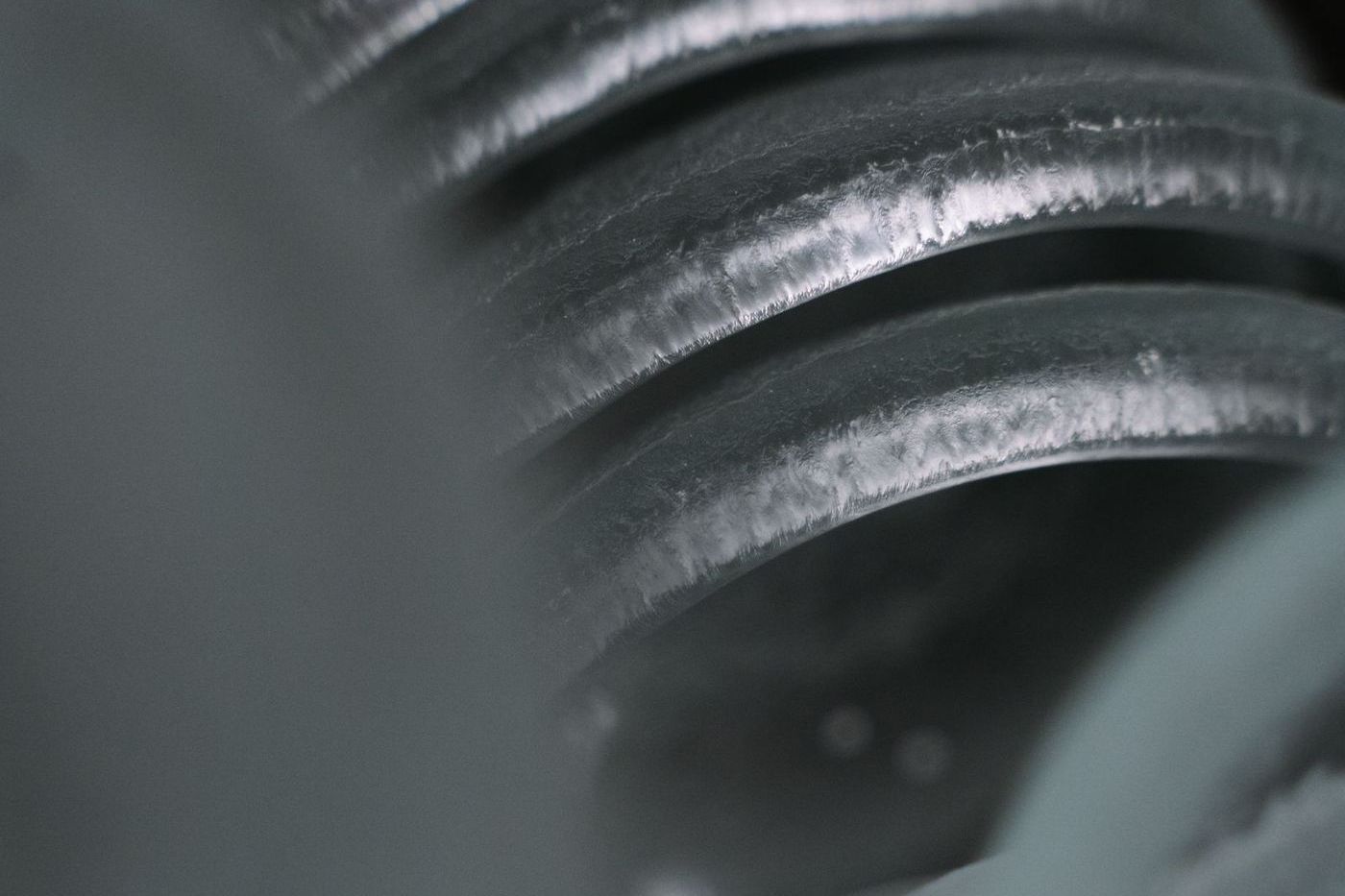
What a Broken Garage Door Spring Looks Like
The sound is the giveaway. A torsion spring failing releases all of its stored energy at once, and inside a closed garage it is loud enough to be mistaken for something hitting the house. Afterwards the garage is quiet and the door does not work.
Walk in and look at the steel shaft running horizontally above the door opening. A torsion spring sits on that shaft, wound tight. When it breaks you will see a clean gap of two or three inches in the coil, and the two ends will have sprung apart. Nothing else on the door looks any different, which is why people often try the opener again before they check.
Older doors, and most detached single-car garages in the older parts of Waco, use extension springs instead. Those run along the horizontal tracks on each side, stretching as the door comes down. A broken extension spring hangs slack, or the door sits crooked because only one side is still pulling.
Either way the symptom is the same: the opener strains, the door lifts an inch or two and stops, or it does not move at all. Sometimes the opener disengages and runs on its own with nothing happening. That is the motor telling you it cannot lift a door that has lost its counterweight.
Do not keep pressing the button. A garage door opener is designed to guide a balanced door, not to lift a heavy one. With a spring gone, every press puts the full weight of the door through the drive gear and the top section. That is how a $250 spring job becomes a $600 job with a stripped opener and a bent panel.
Why Garage Door Springs Break in Waco
Springs do not fail from age so much as from use. Every spring is rated for a number of cycles, and a cycle is one trip up and one trip back down. The standard spring fitted on most doors is rated to about 10,000 cycles. A family that uses the garage as the main way in and out of the house can burn through that in five or six years.
Central Texas conditions push it along. Waco summers leave an unconditioned garage sitting well above 100 degrees for weeks, and the heat and humidity work on the protective coating on the spring wire. Once that goes, the coils start to rust from the inside of the winding where nobody ever looks. Rust between coils means friction, friction means heat, and a spring that has been quietly corroding for a couple of summers is running on borrowed time.
Then the cold finishes it. Waco only gets a handful of genuinely freezing mornings a year, but steel contracts as the temperature drops and the lubricant on the spring thickens. A spring at the end of its cycle life takes that extra load and lets go. After the February 2021 freeze, broken springs across McLennan County followed the same pattern, and every hard cold snap since has done the same thing on a smaller scale.
Door size matters as much as weather. The subdivisions around Woodway, Hewitt and China Spring mostly run one wide sixteen-foot double door hanging on a single torsion spring. That is a lot of weight on one component, and it is why double doors show up disproportionately in spring failures compared with the narrow single doors on the older detached garages closer to downtown.
What Spring Replacement Involves
The job itself is straightforward for someone with the right tools and genuinely dangerous without them. The technician clamps the door in place, releases the remaining tension with winding bars, unbolts the broken spring from the center bracket, slides it off the shaft and fits the replacement. Then the new spring is wound to the correct number of turns for the door height, the set screws are seated on the shaft, and the door is tested for balance.
That balance check is the part that separates a proper repair from a quick swap. A correctly balanced door, disconnected from the opener, will stay put when you lift it halfway and let go. If it drifts down, the spring is under-wound. If it creeps up, it is over-wound. Both shorten the life of the new spring and put load back through the opener.
While the door is apart it is worth having the cables, drums and bearings looked at. A spring that broke violently often takes the lift cables with it, and the end-bearing plates wear at a similar rate. Sorting those at the same visit costs far less than a second call-out.
Torsion or extension, and which spring you need
Springs are not interchangeable. Getting the right one means matching four things: the wire gauge, the inside diameter, the overall length and the wind direction. Fit a spring with the wrong wire size and the door will be out of balance from day one and the spring will fail early. This is why a technician measures rather than guessing from the door size.
If your door is on extension springs, ask about safety cables. These run through the middle of each spring and are anchored at both ends, so that if the spring snaps the pieces stay on the cable rather than flying across the garage. Many older Waco doors were never fitted with them, and they cost very little to add.
Where the door is opened many times a day, high-cycle springs are worth the extra. A 25,000-cycle spring costs more up front and lasts two to three times as long, which usually works out cheaper over the life of the door.
Why This Is Not a DIY Job
Of everything that can go wrong with a garage door, the springs are the one part to leave alone. A torsion spring on a double door stores enough energy to break an arm or worse, and it releases every bit of it in a fraction of a second if a winding bar slips out of the cone. The U.S. Consumer Product Safety Commission has tracked garage door injuries for decades, and spring work accounts for the serious ones.
Screwdrivers are not winding bars, and the difference is not academic. The correct bars are sized to the winding cone and long enough to control the torque. Anything else is a lever that can jump.
What Happens Next
Call and say what you heard and what the door is doing now. Useful details: whether the door is fully down or stuck part way, whether you can see a gap in the spring above the opening, roughly how wide the door is, and whether it is a single or a double. That is enough to know which spring to bring.
You get the price before any work starts. If the cables went at the same time, or the door came off its track when the spring let go, that gets covered as part of the same conversation rather than appearing on the bill afterwards. Related pages worth reading: garage door cable repair, off track door repair, and what garage door repair costs in Waco.